
Universal Child Care is Just the Start: Q&A with Veronica Ramirez
Danielle Horton | August 26, 2026 |
Behind every child care statistic is a family balancing work, school, and caregiving. Ascend Parent Advisor Veronica Ramirez knows firsthand the trade-offs, trust, and community partnerships required for families to thrive. Based in Ohkay Owingeh Pueblo, New Mexico, Ramirez bridges her lived experience with systemic change—advocating alongside policy leaders while working locally to build pathways for family economic mobility, health, and early care support.
Ramirez is a Community Engagement & Programs Coordinator at Breath of My Heart Birthplace, where she supports mothers through their birthing journeys and provides the community with the robust resources they need and deserve.
Grounded in the belief that parents are a child’s first teacher, Ramirez shares her insights on navigating child care and caregiving, community solutions, and the transformative impact of whole-family caregiving in our latest interview. Her story illustrates why Child Care and Caregiving is a pillar of Forward With Families.

Danielle Horton-Strozier: Looking back at your children’s earliest years, what did a typical day of managing child care and caregiving actually feel like for your family behind closed doors?
Veronica Ramirez: They were in my care – at least for the first year of both my kids’ lives. And I was just fortunate enough for that to happen because of my son.
I got pregnant the year I graduated high school, so I took a gap year and I was able to stay home with him. With my daughter, I intentionally worked a lot when I was pregnant, had side hustles. I talked with my employers to be like, Okay, I’m pregnant, I want to be able to take time off. They’re really family-centered organizations, so they understood. So I was able to take off 6 months, and I got benefits, like SNAP and that. So that helped too.
When I went back to work, I slowly transitioned, and I was able to bring my daughter with me, because she was so small that we were able to work it out, and then once she started being mobile is when we were like, OK. She needs a place to go.
I started looking into universal child care here in New Mexico, and I wondered, OK, how does this work? I filled out the application, a case manager called me, and we talked it over. I picked a daycare, did a tour. And then, yeah, she started in December [2025]. I think her first day was December 3rd. So it was a pretty quick turnaround for that, and she’s been there since. She’s there right now, today.
Danielle: How has universal child care in New Mexico impacted you?
Veronica: I think it was a little bit daunting for the daycares, because it’s a reimbursement, and so they’re taking the cost up front, and then they get reimbursed through the state.
So during the transition, I think they wondered, How is this gonna work, you know? To have that kind of capital up front to be able to say, we have this many slots available based on our budget and then to get reimbursed, I think was probably a hard on-ramp for a lot of them.
I really needed to be back and work full-time. I didn’t want to miss this opportunity, so we put up two weeks’ cost for her to hold her spot. It was about $500 just for two weeks, which, I mean, that’s a big amount. But we were able to make it work.
Danielle: Tell us more about your partnership with the LANL Foundation and Santa Fe Community College.
Veronica: I contracted with the LANL Foundation, partnering with Santa Fe Community College and local daycares on an early childhood career track. We’re getting more workers out there by helping students in the cohort earn their bachelors, complete their certification hours, and fill the deficit.
If it’ll help out another mom, I’m all for it. By the time we get daycare at the college or whatever, my daughter, my youngest, is probably already gonna be in Head Start and not even need that service anymore, but if it’ll help future people and their children, I’m all for fighting the fight.
Danielle: Finding quality, trustworthy child care is often one of the first major hurdles for new parents. How did you navigate that journey, and what surprised you most about the process?
Veronica: It takes a village, and it’s hard — it’s pretty much just been me and my partner. If it’s outside of school or daycare hours, either the kids are coming with me, or we’re not going, because that’s just how it is. Everyone has a life and they’re our responsibility. There isn’t a daycare with weekend or evening hours, so the spaces I’m in need to be family friendly or I’m not going to be able to participate, basically.
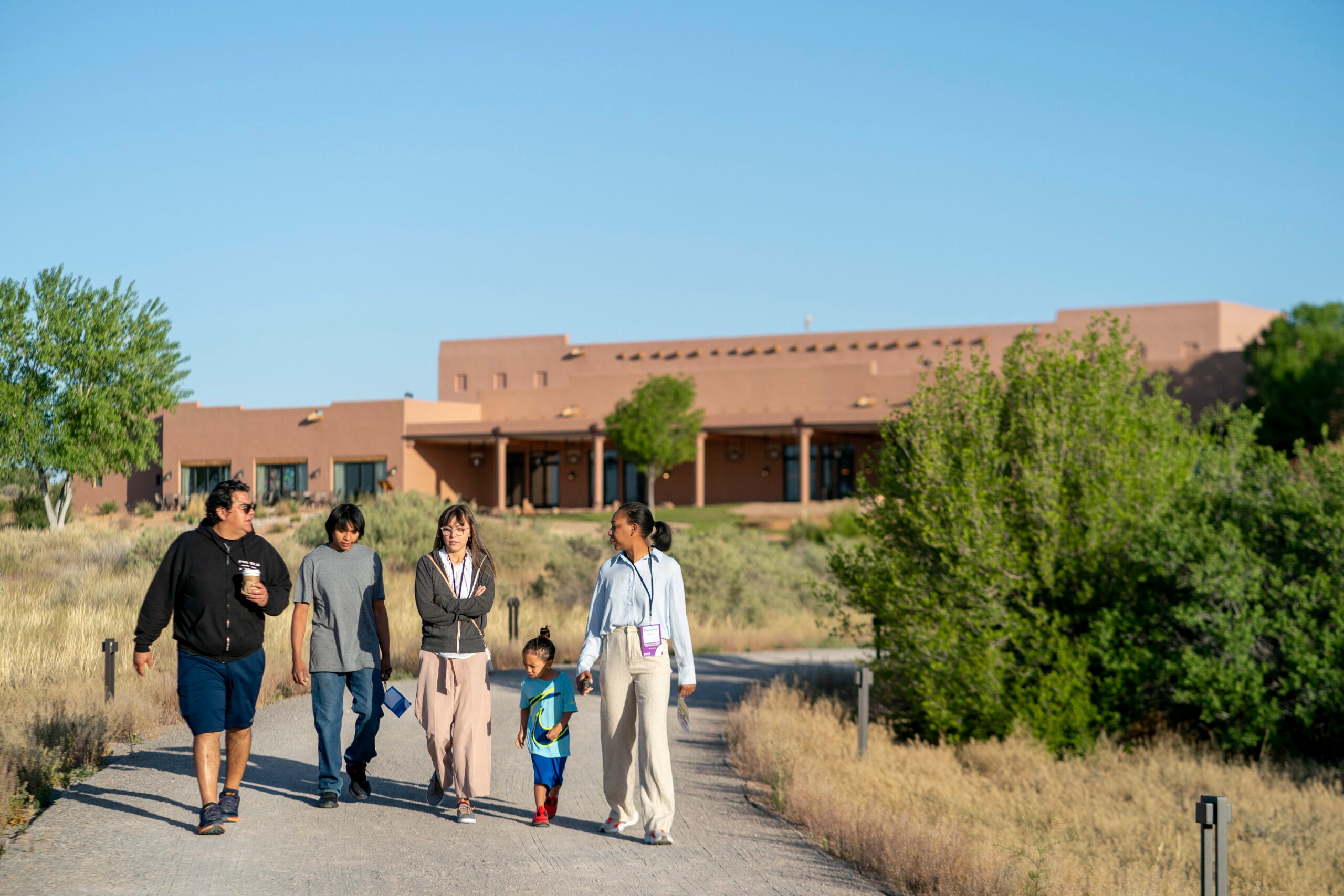
Danielle: Has there been an organization within your community that you have utilized that makes caring for your child and pursuing your dreams that much easier?
Veronica: My work, Breath of My Heart Birthplace, they’re a family-friendly business, and so is the LANL Foundation. So, if my kids don’t have daycare that day, I’ll bring them in. They help work with me, or if there’s an event on a weekend or something, and I need help finding child care, they’ll give me a stipend or help me secure child care so that I can attend and be present so that I can fully serve my community.
I run our food, diaper, and period product distributions, and, having been in their shoes, I treat moms the way I’d want to be treated. If someone misses a distribution, I’ll reschedule, meet them halfway, or drop products off—there’s always a way to get people what they need.
It’s important, because then my kids see it, too. They’re like, ‘That family needs diapers, my mom will help them.’ Taking my son to do this donation for fire evacuees is inspiring him—there’s always a way you can help.
Danielle: As a parent advisor, you advocate for parents as the true experts of their children. What is one thing you wish child care providers or policymakers understood better about the realities parents face?
Veronica: Honestly, we don’t operate 9 to 5 — we’re parents 24/7. I’m putting my baby to sleep at 10 PM while trying to hit school deadlines, work, and show up for my kids. There’s just not enough time, but I’m grateful for a community that gets it.
Where there’s a will, there’s a way. As a non-traditional student, I’m getting this degree while working and paying bills—even if it takes until my kids are adults. I’ll take a meeting from practice if I have to. I’m not ashamed; if I gotta be in two places at once, there I am.
Danielle: Quality care is a term used often in policy, but it means different things to everyone. What are some of your non-negotiables when it comes to making a child care space feel safe, nurturing, and joyful?
Veronica: It has to be clean and safe, but the second biggest thing for me — which isn’t being met right now — is culture. To be surrounded by our people and our language.
No one from her tribe works at my daughter’s current daycare, but in one year she can go to the tribal Head Start where half the instruction is in her traditional language and all the staff is Indigenous. My son goes to a school in a neighboring tribe and gets language every day—he comes home and teaches us. I’m doing my best to support her at home so it’s not a shock when she transitions.
It’s our responsibility. Children learn through repetition, so it’s not only me who needs to show her the language and ways, but everybody around her too. I’m grateful our family has taken that initiative — they’re showing up and doing it.
Danielle: Last question: if you had a magic wand, what would you change to better serve children and families?
Veronica: If I had a wand, I’d get rid of the capitalist structure. It doesn’t serve what we need. In a true village, everybody has a special gift and does what they feel called to do, but right now everything’s controlled by money. I get it — I have to pay bills and keep the lights on — but as parents, our job is to be our kids’ first teachers and help them find their passion.
My son wants to save endangered tigers. I told him, ‘We don’t live near tigers, but we’ll donate to the people who do until you grow up and become a zoologist.’ Whatever path he wants to see through, I will support him however I can.
Related Posts

Ascend has chronicled what it takes to properly support student parents for years, and childcare access is an all-too-common barrier for academic succ...
Across the country, states and localities are setting a new bar for access to high quality affordable childcare. Last year, New Mexico became the firs...
Fifteen years ago, Founder and Executive Director Anne Mosle launched Ascend at the Aspen Institute with a mission to spark and spread breakthroughs i...