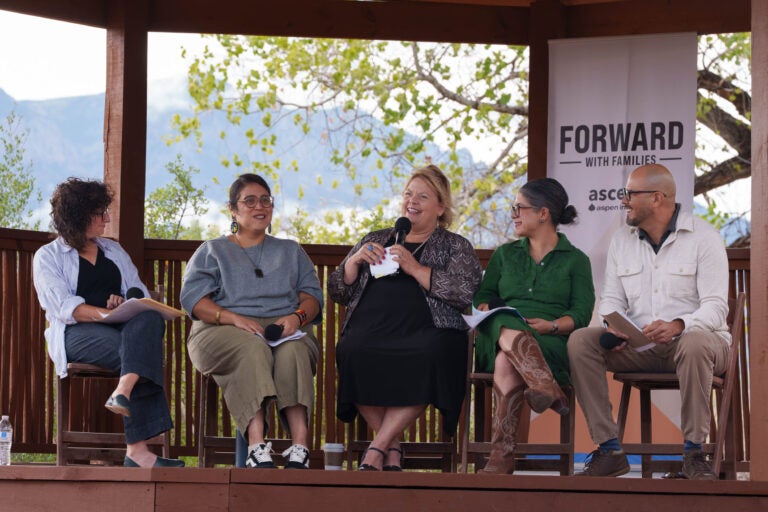
Financial Stability Gives Families Breathing Room to Move Forward
This post is part of the Forward With Families series.
Forward With Families is a multi-year strategy led by Ascend at the Aspen Institute to amplify ideas and initiatives that make life affordable, economic mobility possible, and security attainable for every family in America. This strategy drives policy and systems leaders at every level to act on proven and promising solutions to ensure resources go farthest for the children and families who need them most.
For many families, working hard is not the problem. The problem is living without margin.
Two in three American workers live paycheck to paycheck, and many families lack even a small financial buffer to absorb an emergency, plan ahead, or take a step forward. Missed tax credits, unpredictable income, and sudden benefit losses can turn modest progress into new instability, making it harder to build financial security.
Families experience this as constant pressure: one unexpected expense, one pay increase that triggers a benefits cliff, one missed refund that could have made the difference. When systems penalize progress, families are forced to make careful decisions in unstable conditions.
When financial systems are designed to support stability, families tell a different story.
What Financial Stability Looks Like in Practice
Supporting navigation and planning across tax and benefits systems.
- The benefits cliff — when a modest increase in earnings triggers a sudden loss of public benefits that outweighs new income — punishes progress and limits economic mobility for millions of working families. In Tennessee, the Martha O’Bryan Center launched the Tennessee Alliance for Economic Mobility (TAEM) to reimagine how families navigate this cliff. Its demonstration initiative, Our ChanceTN, pairs whole-family supports with benefits counseling, resource navigation, and a temporary transitional benefit that helps offset losses as income rises. To date, more than 1,300 families have participated, with 41% increasing employment and average household income rising by more than $20,000.
Designed and governed with caregiver voice at its core, Our ChanceTN embeds lived experience throughout implementation, from early surveys and focus groups to ongoing leadership through Peer Ambassadors and a caregiver-led steering committee. Early findings from the program’s randomized controlled trial underscore that high-trust, high-intensity family coaching drives stronger outcomes, reinforcing that relationships matter. - For families navigating work and public benefits, tech platforms like Amplifi’s Benefit Navigator — led by CEO Jill Bauman— help demystify a fragmented and often opaque benefits landscape so families can stabilize, avoid sudden benefit cliffs, and plan for income growth with confidence.
Built from the ground up with caseworkers, families, and supervisors — and grounded in rigorous research from the University of Southern California and ongoing policy maintenance by Policy Engine — the Benefit Navigator makes complex systems more transparent, reducing risk while restoring agency and opening pathways to long-term economic mobility. - StreetCred, co-founded and led by Lucy Marcil at Boston Medical Center, leverages the trusted rhythm of pediatric care to reduce economic strain for low-income families — particularly families of color. It began in Massachusetts and is actively expanding into health systems in states across the country.
Born from a mother’s simple question (“Why can’t you do my taxes at the clinic?”), StreetCred embeds an opt-out, relationship-based bundle of economic mobility services — including free tax preparation, cash-like supports, and trauma-informed financial coaching — directly into prenatal and pediatric visits. By meeting families where trust already exists and following them longitudinally, StreetCred makes economic stability more accessible while treating financial security as a core component of health. - At Nationwide Children’s Hospital in Ohio, the Healthy Neighborhoods Healthy Families initiative—led by Nick Jones—has offered free family tax preparation since 2020 in partnership with United Way of Central Ohio. Informed by place-based advisory councils, clinics were intentionally located near transit lines, expanded into larger community spaces, and paired with referrals to legal aid and essential services — recognizing tax appointments as trusted moments to connect families to broader economic supports.
Today, through its 614 File Free program, Nationwide prepares more tax returns than any hospital in the country, serving more than 2,600 families and returning over $5 million in refunds. With expansion across Franklin County and advocacy to make Ohio’s Earned Income Tax Credit refundable, the program demonstrates how healthcare-based, community-rooted tax initiatives can scale access, strengthen financial stability, and support families year-round.
Expanding access to guaranteed income programs
- Magnolia Mother’s Trust — led by Aisha Nyandoro — is the longest-running guaranteed income initiative in the United States and the first to focus on extremely low-income families led by Black mothers. Based in Jackson, Mississippi, the program was co-designed with participating families, who helped determine the monthly amount, duration, and complementary supports to include. The program provides $1,000 per month for 12 months with no conditions attached.
Ongoing, community-driven evaluation shows that predictable cash — paired with family-informed supports — strengthens financial stability, autonomy, well-being, and social capital, demonstrating how trust-based income models can expand opportunity without reducing workforce participation. - The Steelcase Foundation’s Investment in Families Initiative (IIF) — led by Daniel Williams— is a 10-year participatory research project that uses surveys, focus groups, and close collaboration with a cohort of 30 family leaders in Kent County, Michigan to study the impact of wraparound supports – such as monthly guaranteed basic income – designed to reduce mental cognitive load and increase personal agency. Launched in August 2024, IIF centers the experiences and leadership of mothers to shape research, inform policy, and drive narrative change that benefits families across Michigan.
Why This Matters–Now
Breathing room changes behavior.
Across communities, financial systems designed to support progress are making work viable and stability possible. Evidence from guaranteed income pilots consistently shows improved stability and well-being without reducing work. Because when families have breathing room, work becomes more viable.
Moving Forward With Families
What’s already working across communities makes the path forward clear: design financial systems that support progress, smooth volatility, and trust families’ judgment.
Forward With Families elevates these proven and promising approaches and helps move them from practice to policy — so families can build stability without risking setbacks at every step.
How are you moving families forward? We invite you to share your work to help map the momentum and spark new opportunities for connection, collaboration, and support. Tell us how you’ll take action here.
Related Posts