
When A State Leads Boldly
New Mexico’s Path to Universal,
No-Cost Childcare
By Stephanie Brueck-Cassoli


This fall, Governor Michelle Lujan Grisham announced that New Mexico would become the first state to provide no-cost universal childcare. And yes, truly universal and no-cost for all New Mexicans, along with a recommended wage floor of $18/hour for childcare providers. The early childhood education sector nationwide still faces real challenges; the cost of childcare has risen to prohibitive levels for families and wages are not rising to match the demand on the sector. But when no-cost universal childcare officially starts on November 1, 2025, it will bring hope and momentum for children and families in New Mexico and across the country.
“It’s about increasing access and care for families,” says Jovanna Archuleta, Early Childhood Education Program Director at LANL Foundation and a 2022 Aspen Institute Ascend Fellow. “That’s what it’s all about and what we do this for."
How did New Mexico get to this milestone and what does this mean for families in New Mexico?
Building a Shared Voice
The road to no-cost universal childcare in New Mexico started 15 years ago with efforts to establish a new cabinet-level state agency that combined all early childhood services across three departments into one. In 2019, New Mexico created the Early Childhood Education and Care Department (ECECD) under the leadership of Secretary Elizabeth Groginsky. The decisions that were made to create this department and the legislative actions that have been taken since have been deliberately focused on bringing New Mexico from 50th in the nation on child well-being to first.
One of the most remarkable aspects of New Mexico’s journey is how a diverse network of partners, advocates, funders, tribal leaders, educators, and policymakers found ways to move forward with a shared purpose. In a field where priorities often compete, New Mexico’s leaders cultivated a rare ability to “speak with one voice.”
A backbone to developing “one voice” came from philanthropy-funded coalition groups led by Growing Up New Mexico, Voices for New Mexico’s Children, and ENGAGE New Mexico. Weekly meetings became spaces for real-time updates, strategy refinement, and adjusting messaging so that every sector stayed coordinated. This culture of openness allowed leaders to stay agile while maintaining a unified narrative about what families need most.
Philanthropy was instrumental in sustaining that alignment. Local and national funders not only provided resources to fund those coalitions but also modeled collaboration themselves—meeting monthly to align grantmaking, co-funding shared initiatives, and ensuring investments reinforced rather than fragmented progress. The LANL Foundation further funded the Rio Arriba County Early Childhood Collaborative and launched the Pueblo Outreach Project along with the Eight Northern Indian Pueblos Councils, funded by the W.K. Kellogg Foundation, to lay essential groundwork for Tribal and Rural partnership in New Mexico’s early childhood system.
This shared voice was also fueled by science and moral urgency. With New Mexico historically ranked near the bottom in child and family well-being, leaders understood that the data told a story they could no longer accept. Brain science had long underscored the importance of early development, and in New Mexico, it was a clear, evidence-based reason to act with urgency and compassion.
Above all, relationships remain at the heart of this success. In a state where access to leadership is direct and personal, advocates can walk into a cabinet secretary’s office or call a legislator to talk through ideas. That proximity has created a culture of accountability and possibility that continues to define the state’s progress.


Building a Shared Voice
The road to no-cost universal childcare in New Mexico started 15 years ago with efforts to establish a new cabinet-level state agency that combined all early childhood services across three departments into one. In 2019, New Mexico created the Early Childhood Education and Care Department (ECECD) under the leadership of Secretary Elizabeth Groginsky. The decisions that were made to create this department and the legislative actions that have been taken since have been deliberately focused on bringing New Mexico from 50th in the nation on child well-being to first.
One of the most remarkable aspects of New Mexico’s journey is how a diverse network of partners, advocates, funders, tribal leaders, educators, and policymakers found ways to move forward with a shared purpose. In a field where priorities often compete, New Mexico’s leaders cultivated a rare ability to “speak with one voice.”
A backbone to developing “one voice” came from philanthropy-funded coalition groups led by Growing Up New Mexico, Voices for New Mexico’s Children, and ENGAGE New Mexico. Weekly meetings became spaces for real-time updates, strategy refinement, and adjusting messaging so that every sector stayed coordinated. This culture of openness allowed leaders to stay agile while maintaining a unified narrative about what families need most.
Philanthropy was instrumental in sustaining that alignment. Local and national funders not only provided resources to fund those coalitions but also modeled collaboration themselves—meeting monthly to align grantmaking, co-funding shared initiatives, and ensuring investments reinforced rather than fragmented progress. The LANL Foundation further funded the Rio Arriba County Early Childhood Collaborative and launched the Pueblo Outreach Project along with the Eight Northern Indian Pueblos Councils, funded by the W.K. Kellogg Foundation, to lay essential groundwork for Tribal and Rural partnership in New Mexico’s early childhood system.
This shared voice was also fueled by science and moral urgency. With New Mexico historically ranked near the bottom in child and family well-being, leaders understood that the data told a story they could no longer accept. Brain science had long underscored the importance of early development, and in New Mexico, it was a clear, evidence-based reason to act with urgency and compassion.
Above all, relationships remain at the heart of this success. In a state where access to leadership is direct and personal, advocates can walk into a cabinet secretary’s office or call a legislator to talk through ideas. That proximity has created a culture of accountability and possibility that continues to define the state’s progress.
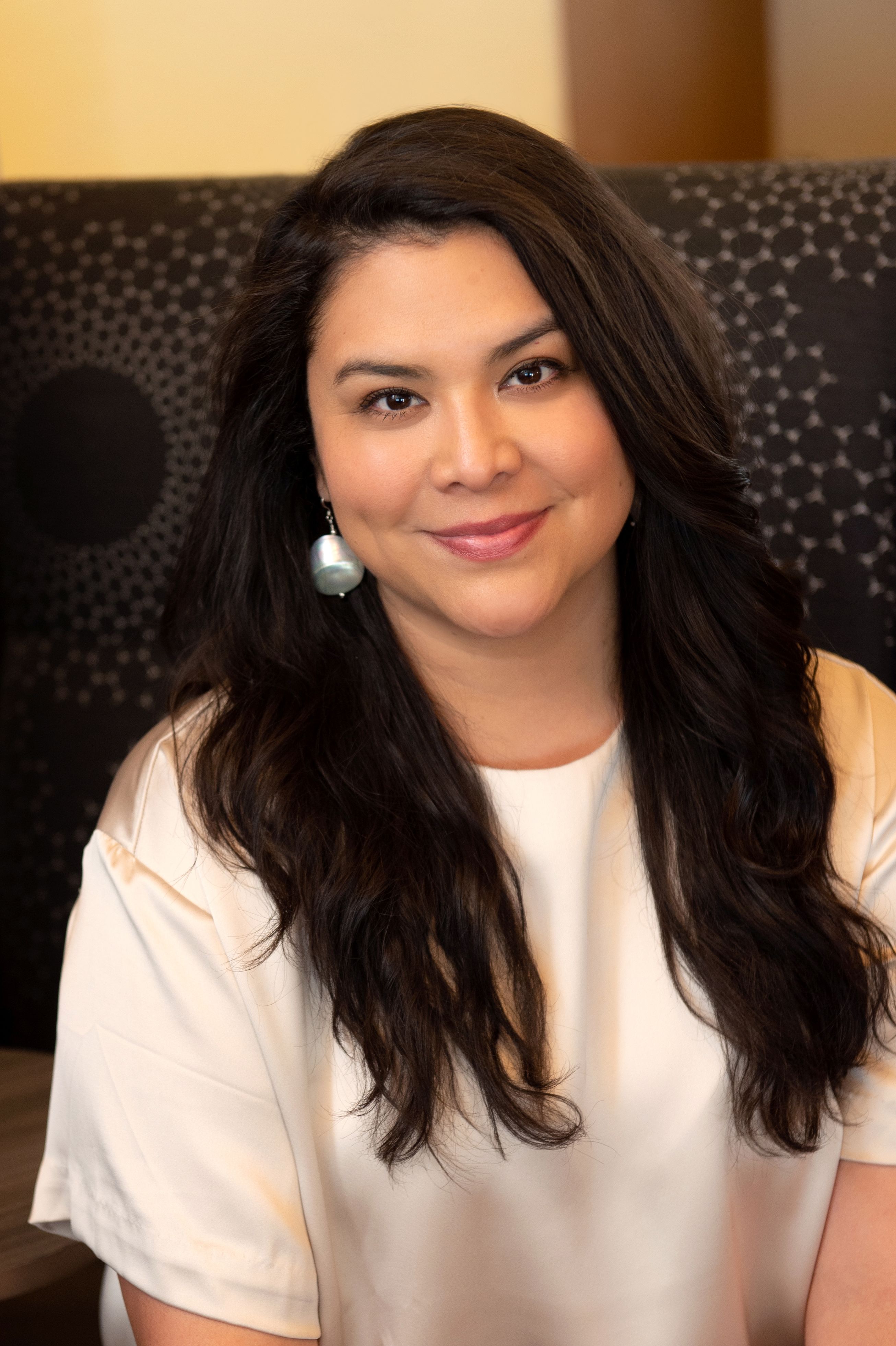
"We’re used to having to fight until we win. We’ll keep doing what we have to do for families; it’s never a defeat.”
Jovanna Archuleta
Early Childhood Education Program Director at LANL Foundation, former Assistant Secretary for Native American Early Childhood Education ECECD, and 2022 Ascend Fellow

Lessons for the Nation
A defining lesson from New Mexico’s journey to no-cost universal childcare is the value of resilience; legislation failed seven times along the way. Meanwhile, state leaders, coalition groups, and philanthropists worked together to get creative to secure key wins, such as establishing the Early Childhood Trust Fund, the interest of which helps fund the department. This persistence, rooted in generational commitment, is one of the state’s most transferable lessons for others seeking transformation.
Another is the recognition that systems change must be multidimensional. Early on, the notion of a “Power Flower” was introduced to recognize that in order to move policy that is community and family-centered, there needs to be alignment among coalitions to engage decision makers and hold them accountable. In New Mexico’s journey, each petal mattered. Grassroots mobilization worked hand in hand with philanthropy, government, and everyday citizens to create pressure and momentum that no single institution could generate alone.

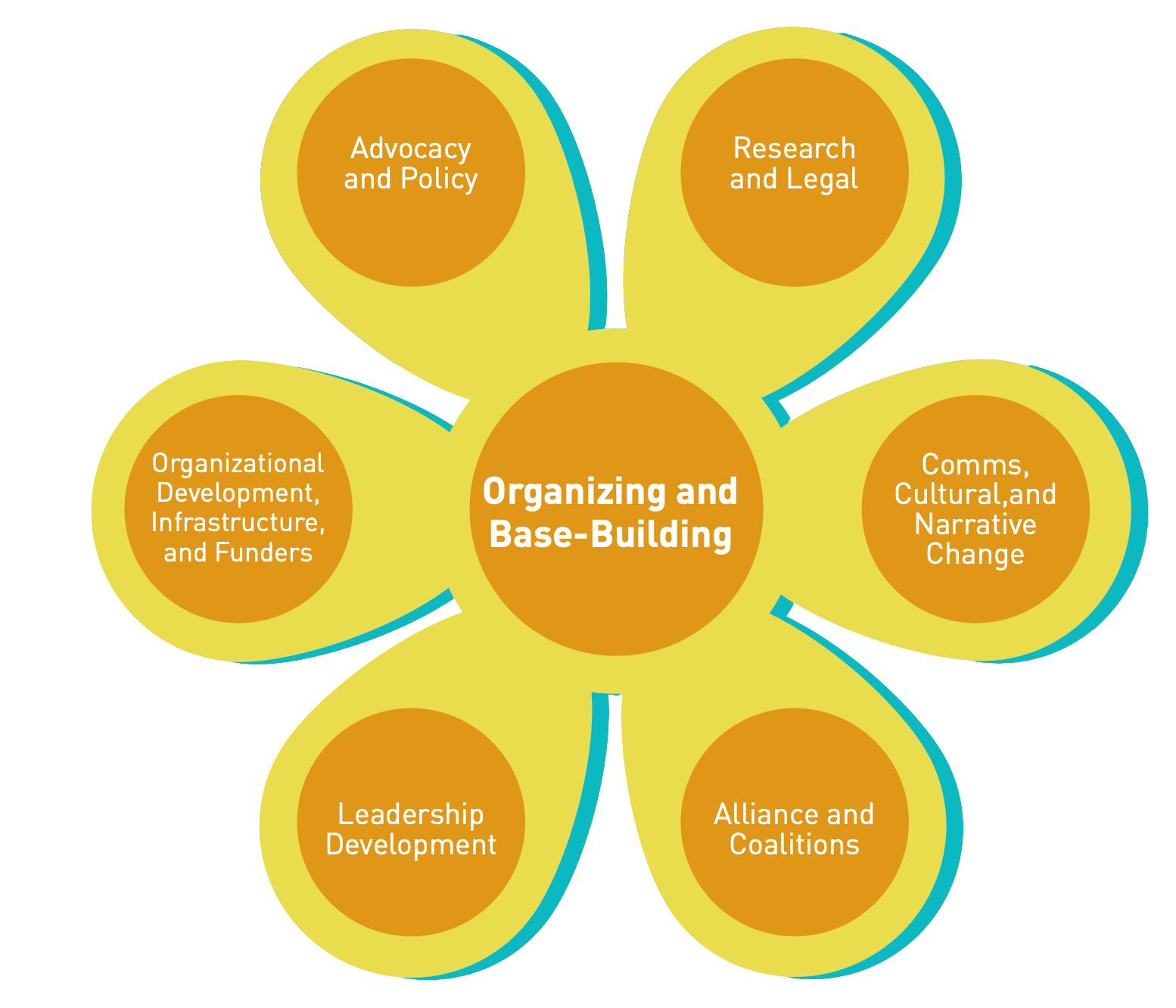
Power-Building Ecosystem Framework by USC Program for Environmental and Regional Equity (2020).
Power-Building Ecosystem Framework by USC Program for Environmental and Regional Equity (2020).
New Mexico’s success also offers a reminder that every state starts from a different place, and progress can take many forms. Across the U.S., there are promising echoes of this movement with more states redefining early childhood care and governance, from Texas securing new early childhood investments, to Illinois and Colorado creating their own departments of early childhood, to the Navajo Nation Early Childhood Collaborative.
Leadership has also been key, with significant appreciation for Secretary Elizabeth Groginsky (ECECD) specifically. The combination of her systems thinking and deep knowledge of childcare have guided the department through rapid growth and implementation. And while New Mexico benefited from unique financial resources, such as revenue from oil and gas reserves, other states are finding creative pathways of their own—whether through wealth taxes, excise taxes, or philanthropic partnerships. The lesson is not to replicate New Mexico’s exact formula, but to embrace its spirit: persistence, partnership, and belief in the collective power of families and communities to drive transformation.
Lessons for the Nation
A defining lesson from New Mexico’s journey to no-cost universal childcare is the value of resilience. Legislation failed seven times before passing to achieve the first step of this journey, which was the creation of ECECD. Meanwhile, state leaders, coalition groups, and philanthropists worked together to get creative to secure key wins, such as establishing the Early Childhood Trust Fund, the interest of which helps fund the department. This persistence, rooted in generational commitment, is one of the state’s most transferable lessons for others seeking transformation.
Another is the recognition that systems change must be multidimensional. Early on, the notion of a “Power Flower” was introduced to recognize that in order to move policy that is community and family-centered, there needs to be alignment among coalitions to engage decision makers and hold them accountable. In New Mexico’s journey, each petal mattered. Grassroots mobilization worked hand in hand with philanthropy, government, and everyday citizens to create pressure and momentum that no single institution could generate alone.
Power-Building Ecosystem Framework by USC Program for Environmental and Regional Equity (2020).
Power-Building Ecosystem Framework by USC Program for Environmental and Regional Equity (2020).
New Mexico’s success also offers a reminder that every state starts from a different place, and progress can take many forms. Across the U.S., there are promising echoes of this movement with more states redefining early childhood care and governance, from Texas securing new early childhood investments, to Illinois and Colorado creating their own departments of early childhood, to the Navajo Nation Early Childhood Collaborative.
Leadership has also been key, with significant appreciation for Secretary Elizabeth Groginsky (ECECD) specifically. The combination of her systems thinking and deep knowledge of childcare have guided the department through rapid growth and implementation. And while New Mexico benefited from unique financial resources, such as revenue from oil and gas reserves, other states are finding creative pathways of their own—whether through wealth taxes, excise taxes, or philanthropic partnerships. The lesson is not to replicate New Mexico’s exact formula, but to embrace its spirit: persistence, partnership, and belief in the collective power of families and communities to drive transformation.
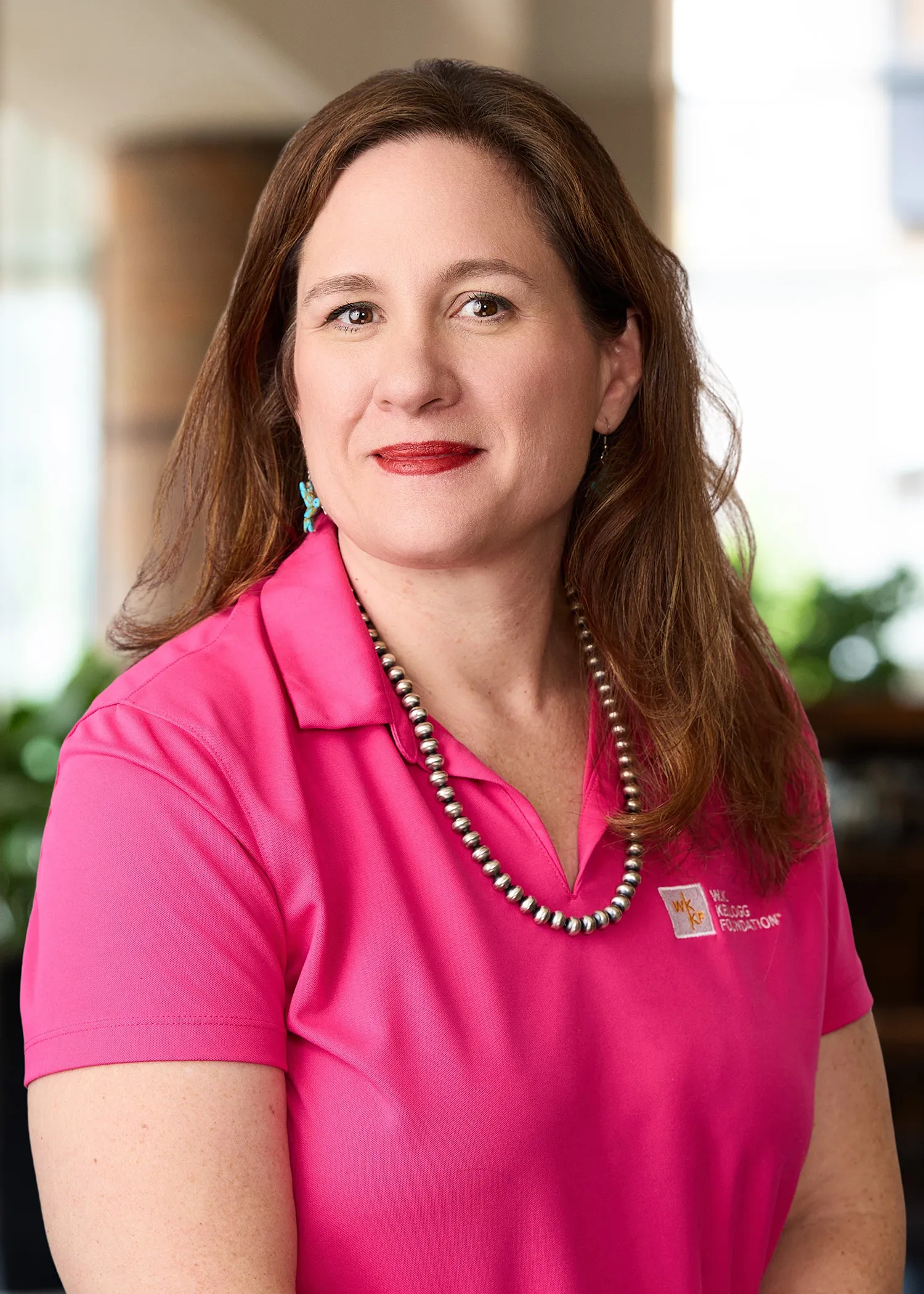
“We won’t see outcomes for several years and this was never a hard sell. All in New Mexico have been really bought into the importance of investing in early childhood since the beginning.”
Jennifer Duran-Sallee
Senior Program Officer and W.K. Kellogg Foundation and former Deputy Secretary, New Mexico Early Childhood Education & Care Department

The Work Ahead
Even as New Mexico celebrates its historic achievement, leaders are clear-eyed about the work ahead. New Mexico’s ECECD is only five years old. Its full impact will unfold over generations. The challenge now is to sustain momentum, deepen quality, and ensure that the early gains for children carry forward into the K–3 system and beyond.
Providers and small business owners have questions on how this will work. The pushback is not insignificant and workforce capacity looms largest. To meet the promise of universal childcare, the state will need roughly 12,000 additional childcare slots, requiring not only more providers but also stronger pipelines for training and long-term professional recognition for early educators. Expanding and professionalizing home-based providers is central to this goal to build up the workforce quickly and ensure that rural communities in New Mexico have access to high quality childcare. On the other hand, there is tremendous enthusiasm from New Mexico’s workforce and economic development sector, as increased access to high quality childcare means less interruption of working hours. The higher wage floor for childcare providers also further incentivizes new teachers to enter the workforce, which is further supported through New Mexico’s free college program.
New Mexico’s story reminds us that when state leaders, philanthropy, and communities align behind a shared vision, real transformation is possible — and sustainable. The movement for universal, high-quality, and affordable childcare is not limited to one state; it’s a national imperative. As other states consider how to build systems that work for whole families, New Mexico’s experience calls us to act boldly, invest deeply, and believe that every child and caregiver deserves the same chance to thrive.
Additional Resources
To dig deeper into New Mexico's path to universal, no-cost childcare, check out these resources:
- Jeanna Capito, Jessica Rodriguez-Duggan, Simon Workman, “Understanding the cost of quality child care of New Mexico,” (Prenatal to Five Strategies, 2021).
- Prenatal-to-3 Policy Impact Center (2024). Transforming State Early Childhood Governance: A Case Study of New Mexico. Peabody College of Education and Human Development. Vanderbilt University.
- Click here to access all reports and plans published by ECECD
- Burkhart, G. and McKee, M. (Hosts). (2025, September 30). New Mexico Offers Free Childcare. What’s The Catch? [Audio podcast interview]. In New Mexico News Insiders.
- King, N. (Host). (2023, March 27). New Mexico Low-Key Fixes Child Care. [Audio podcast interview]. In Today, Explained.
 Built with Shorthand