
Charting a Family-Friendly Future in Higher Education
August 19, 2025 | Aspen Postsecondary Success for Parents
Imagine the postsecondary experience. Is it smiling with friends on a grassy quad, carefree and in your early twenties, with final exams as your biggest concern?
This may be the stereotypical student that colleges are built around—but what about the one in five college students who are also parents?
For them, ideal campuses may mean playgrounds near classrooms, flexible attendance policies for children’s doctor’s appointments, or resource centers stocked with family essentials.
To reimagine family-friendly campuses, Ascend at the Aspen Institute convened student parents and leaders from El Paso Community College (EPCC), Long Beach City College (LBCC), Los Angeles Valley College (LAVC), and Montgomery College (MC). As part of the Postsecondary Leadership Circle Activation Fund, these campuses spent two years advancing strategies to support student parent success.
To close out the Fund, the colleges participated in a final gathering where five powerful takeaways emerged.
- Conduct Outreach That Signals Belonging
Imagine arriving on campus juggling a backpack, diaper bag, and exhaustion from a sleepless night. Scanning the hallways and websites, you see nothing that reflects your experience. For many student parents, that isolation is the norm—but it doesn’t have to be.
At LBCC, the Parents BeLong campaign sent a powerful message by including parents in their marketing materials. As student parent Stephanie Rivera shared, “Participating in the vision for the Parents BeLong campaign at LBCC was truly empowering, showing its commitment to recognizing and supporting its student parents.”
Similarly, LAVC made its campus more navigable and inclusive by developing a family-friendly campus map. These tools didn’t just improve access—they signaled that student parents belonged.
- Center Student Parent Voices as Experts and Co-Creators
Picture this: in a meeting, administrators unveil a new service designed for student parents—implementation ready to go. But when a student parent is finally asked for feedback, they point out that the service only operates during typical work hours, which doesn’t accommodate their schedules. Scenarios like this happen all too often.
Connecting with student parents creates lightbulb moments. When they are architects instead of afterthoughts, institutions create solutions rooted in lived experiences.
EPCC surveyed their student parents and then followed up with focus groups to inform their 2Gen strategy. Through this, they learned that in addition to extended hours of operation, a marketing campaign is essential to ensure student parents know what support is available.
- Leverage Data, With Heart & Purpose
Student parents often move through campus unseen—leaving right after class to manage work, care, and study. Without thoughtful data collection, their needs remain invisible.
When institutions collect the right data, they gain insight to create equitable policies and sustain real change. At EPCC, adding a question to their admissions application and creating a services tracker allowed them to launch data dashboards that track outcomes and spotlight areas for growth. With support from Institutional Research and Information Technology, and in partnership with the Urban Institute and the Texas Higher Education Coordinating Board, EPCC is using this data to drive systemic solutions that support student parent success and upward mobility.
- Support Students Early
Early, intentional support for student parents isn’t just helpful—it can be transformational. Sometimes a timely word of encouragement from a counselor, a tip in a brochure, or staff that understand your reality can lay the groundwork for long-term success.
Joshua Wyner of Aspen’s College Excellence Program shared data from Columbia University’s Community College Research Center showing that students who selected a program of study within their first year were far more likely to earn a credential within five years.
To help student parents reach that milestone, Montgomery College (MC) created professional development courses to equip faculty and staff with tools to support parenting students. Shaped by student input, the training covers Title IX, inclusive teaching, and flexibility in the classroom.
LAVC conducted direct outreach to student parents who applied to the college but never enrolled to determine what barriers they were facing and to assist them in overcoming obstacles such as submitting necessary financial aid documents or receiving guidance on academic planning.
- Unite and Align Family-Friendly Efforts Across Campus
For many student parents, accessing support can feel like navigating a maze. Childcare in one office, financial aid in another, and academic advising somewhere else entirely. When services are siloed, access becomes yet another barrier.
At LBCC, the launch of the Student Parenting Hub transformed how student parents access support. By bringing key resources together in one centralized, accessible space, the Hub made it easier for students to get what they need, when they need it.
When these strategies are implemented and sustained together, they transform the student parent experience. As participants of the convening put it, “Strong families make strong communities—and bright futures!.”
Creating family-friendly campuses involves rethinking higher education’s design. When colleges center student parents, they move beyond one-size-fits-all models to build learning environments that are more flexible, inclusive, and responsive to today’s realities. The effects are profound: children see their parents succeed and begin to envision a future for themselves, faculty and staff become more empathetic and equipped, and institutions become more equitable. The work of EPCC, LBCC, LAVC, and MC shows that this future is not only possible—it’s already underway. Now is the time to invest in the policies, practices, and mindsets that affirm what student parents have always known: strong families are the foundation of strong futures.
Related Posts
This month, Virginia took a meaningful step forward for families. Both chambers of the Virginia General Assembly passed HB 427, legislation requiring ...

When we invest in families, we create change that lasts. Amber Angel’s story – from student parent to funder – brings Ascend’s mission to life...
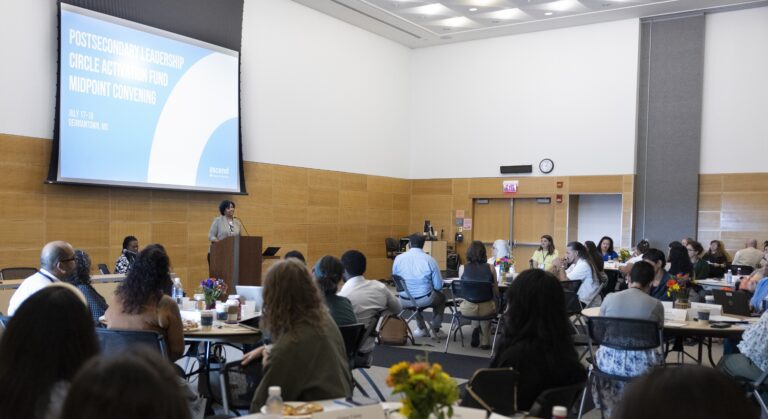
In July, Ascend at the Aspen Institute hosted the Postsecondary Leadership Circle Activation Fund Midpoint Convening at Montgomery College.

As a former student parent and Ascend PSP Parent Advisor, I have been provided a myriad of platforms to elevate the student parent experience, and I a...
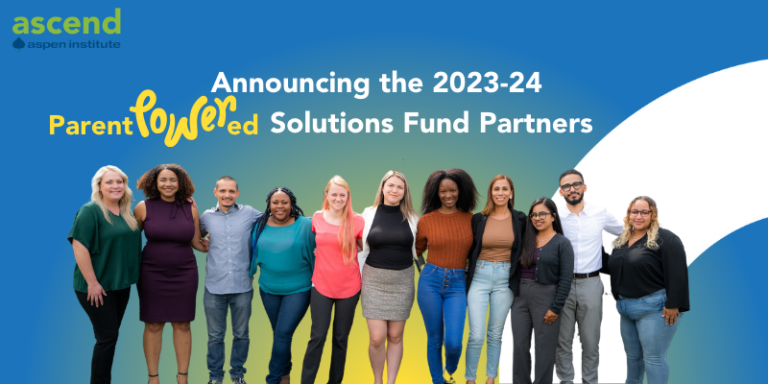
Today, Ascend is excited to announce our 2023-24 Parent-Powered Solutions Fund Partners, six organizations and institutions from across the country wh...

An episode of firsts! Our first live episode recorded at the inaugural Ascend Parent Advisor Convening in Aspen, CO in front of an audience of student...

Today, Ascend at the Aspen Institute announced that four community colleges from across the United States have been selected as partners to its Postse...

Snapshots from the 2023 Ascend Parent Advisor Convening in Aspen, Colorado.

What does college success look like for Black and Native student parents? This podcast episode sheds light on student parents’ and administrators’...
Ascend at the Aspen Institute is excited to announce the launch of the 2023 Parent-Powered Solutions Fund, which will provide financial resources and...

Reflections on the experiences, challenges, and joys that shape the life of student father and Ascend PSP Parent Advisor Christian Ortiz.
Among the one in five postsecondary students who are parents, there are close to 1.1 million student fathers. This chartbook synthesizes the available...
Today, Ascend at the Aspen Institute (Ascend) released the second season of “1 in 5,” its highly rated podcast that explores the multifaceted live...

On May 9, members of the Ascend team had the opportunity to visit Santa Fe Community College in New Mexico. Here are three takeaways from our site vis...

In an Inside Higher Ed article, David Croom and Generation Hope provide important perspective into why the student parent population is important for ...